RIERA STUDIO
ART BRUT PROJECT CUBA
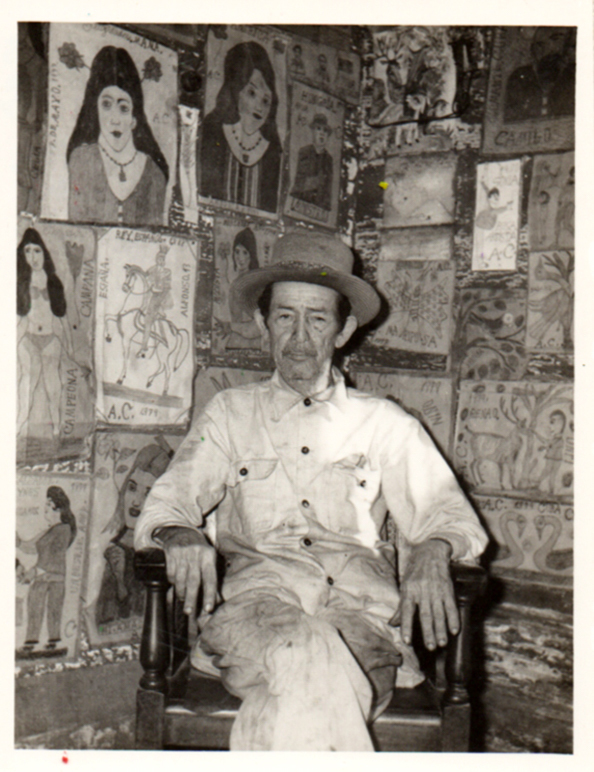
AMÉRICO CRUZ
La Salud, 1902 - 1990
Américo Cruz grew up with seven siblings in a humble home in a rural area on the outskirts of Havana. When he was six years old, his parents decided to move to a small settlement near the village of Quivicán (Mayabeque, Cuba), hoping to improve their economic situation. There, he began studying at a wooden school in the mountains. In the afternoons, he helped his father work the land. He had a passion for painting from that time on.
He got married in 1925 and lived in the countryside for over 15 years until he moved to La Salud in the 1940s. He earned a living working as a sugarcane cutter, cart driver, and cook. In 1941, he decided he wanted to be a painter. However, due to his precarious living situation, he was unable to pursue formal studies. Instead, he became a "brush painter" passionate about decorating the borders and motifs of kitchens and terraces in the houses where he worked.
The exact date of when he first transformed torn or used paper into beautiful creations that have reached our time is unknown.
He only needed a couple of pencils, some chalk, and a stray crayon to create them. He also made his own brushes and other painting tools. In his village, he was often seen with crayons and chalk in his pockets. He painted on incredible surfaces, such as cardboard plates, mimeographed sheets, the reverse sides of diplomas, butter boxes, posters, and fiberboard strips. When inspiration struck, he seized the first thing within his reach.
He did not study painting. He was unfamiliar with proportions and fashionable colors. To him, life's richness could be captured in two multicolored dimensions. It could be transformed into a flat world where people always kept their eyes open and joined their fingers as if they were wearing helmets. One or several stars could shine at will in the empty spaces of the paper.
He lived in total anonymity for almost his entire life. It was not until he was eighty years old, at the beginning of the 1970s, that a group of artists called "Insunsa" "discovered" him. From then on, he participated in various painting exhibitions and cultural events at the provincial and national levels. However, Americo remained the same painter throughout, indifferent to aesthetic budgets and trends in the artistic and cultural scene. His old house in La Salud became his own museum. Its walls housed a significant portion of the creations Americo produced every day and night until he fell asleep.
After a long illness, he passed away in 1990 at the age of 88. Unfortunately, his house-museum deteriorated over time until it eventually collapsed. Due to a lack of appropriate storage conditions, most of his work was lost. Only a small portion of his drawings and some photographs has been preserved thanks to the efforts of the artists Jorge Báez Gonzáles and José Ramón Llanes.